
MDF vs Pot Odds: How Much Should You Defend?
Learn how to calculate MDF, compare it with pot odds, and use both to analyze river decisions.

Pot odds, equity and expected value are the foundations of poker math.
They are easy to grasp even for math-averse players, and most of our readers already apply them at the tables. In this article we go one step further and explain a slightly more advanced concept: minimum defense frequency (MDF). You'll learn how to calculate MDF, how it differs from pot odds, when it's worth using, and how it relates to its counterpart, alpha (α).
What Is Minimum Defense Frequency (MDF)?
Minimum defense frequency is the portion of your range you need to continue with, by calling or raising, when facing a bet. If you defend less often, your opponent can profitably bluff with zero-equity hands.
The MDF Formula
MDF = pot size / (pot size + bet size)
In this formula, pot size means the pot before your opponent's bet.
MDF Example
Let's say you reach the river as the Big Blind against the Button. The pot is $100 and your opponent bets big: $200. How much of your range should you defend, at least in theory?
$100 / ($100 + $200) = 0.33, or 33%
That's the minimum defense frequency in this spot. Looked at from the bettor's side, a pure bluff risks $200 to win $100, so it needs you to fold 67% of the time to break even. If you fold more often than that, every bluff shows an automatic profit. If you defend at least 33% of your range, it doesn't.
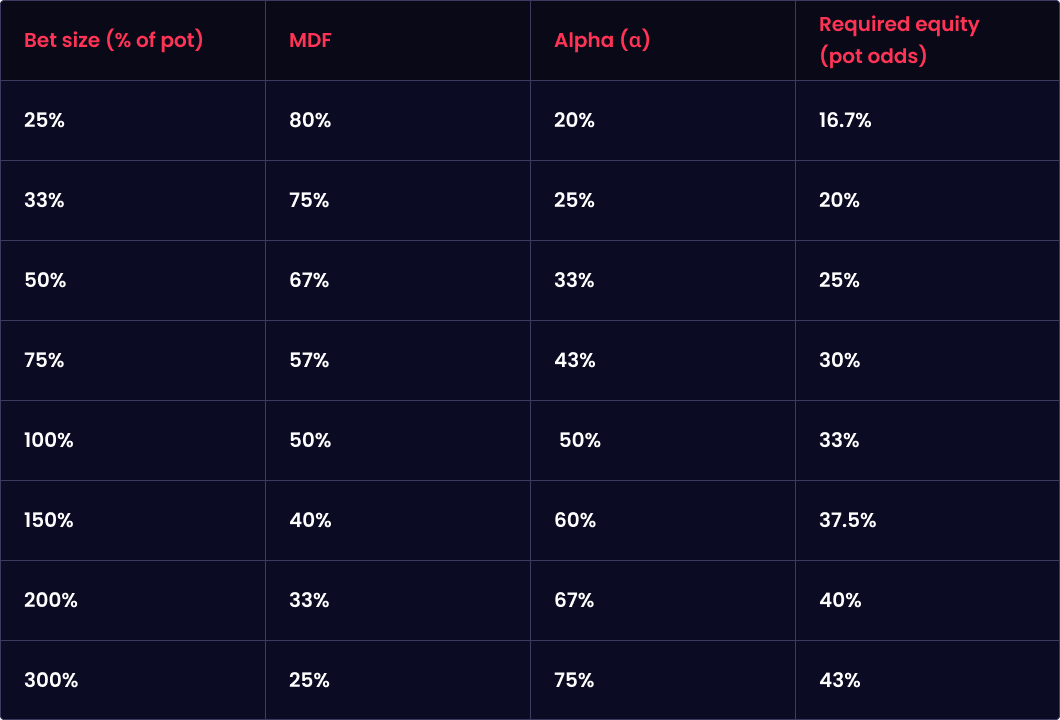
Keep in mind that these figures are reference points, not automatic calling targets. MDF helps you avoid being exploited by bluffs. If your opponent rarely bluffs in a particular spot, defending at MDF may mean calling with hands that lose money against their betting range.
MDF vs. Pot Odds: What's the Difference?
So why bother calculating MDF instead of sticking to pot odds? The two concepts answer different questions.
Pot odds tell you how much equity your specific hand needs for a call to be profitable. Say your opponent bets $100 into a $100 pot on the river. You call $100 to win $200, which gives you pot odds of 2:1. Converted into required equity:
call amount / (pot before bet + bet + call amount) = $100 / ($100 + $100 + $100) = 33%
On the river your hand either wins or loses at showdown, so this simply means it has to win more than one third of the time.
MDF tells you how much of your entire range should continue. In the same pot-sized bet spot:
$100 / ($100 + $100) = 50%
In theory, you should defend half of your river range to avoid being exploited.
The two numbers are also connected. In a simplified river example with a polarized betting range, the share of bluffs in the bettor’s range equals the defender’s required equity. Against a pot-sized bet, that means one bluff for every two value bets: bluffs make up 33% of the betting range. A bluff-catcher that beats every bluff and loses to every value bet is then indifferent between calling and folding.
In short: pot odds are about a single hand, and MDF is about your whole range. Pot odds tell you whether a particular call is profitable. MDF tells you how much of your range must continue so that your opponent can't profit automatically by bluffing.
When Should You Use MDF?
MDF is a lot like GTO strategy in general. It's a powerful tool, but applied blindly it can do more harm than good. We recommend relying on it when two conditions are met.
1. You're facing a bet on the river. Technically, MDF applies on every street. On the flop and turn, however, bluffs almost always have some equity. That has to be factored in, which makes the calculation far more complex and hard to do in real time. Stick to river spots until you're comfortable applying MDF there.
2. Your opponent is capable of bluffing enough, or even overbluffing. Most players struggle to find enough river bluffs, or don't care about being balanced at all. Building a sound bluff-to-value ratio isn't easy. Even winning players struggle with it in spots where the way the hand played out limits their bluffing range. For MDF to be useful, you have to credit your opponent with the ability to bluff often. In practice, that means either an unknown player you assume to be strong, or someone you know bluffs at a sufficient frequency.
So far we've looked at MDF from the defender's perspective. But what happens when you're the one bluffing? That's where alpha comes in.
What Is Alpha (α) in Poker?
Alpha is closely tied to minimum defense frequency. It tells you how often a bluff needs to succeed, that is, how often your opponent must fold, for the bluff to break even.
α = bet size / (pot size + bet size) = 1 − MDF
Say you bet $75 into a $100 pot on the river:
MDF = $100 / ($100 + $75) = 57%
α = 1 − 0.57 = 43% (or $75 / $175)
So when you bet ¾ pot on the river with a bluff that never wins at showdown, your opponent needs to defend 57.1% of their range to stop you from profitably bluffing with any two cards. Put the other way: if they fold more than 42.9% of the time, your bluffs make money.
Alpha gives you a break-even threshold, not a prediction of how often your opponent will fold. To decide whether to bluff, you still need to estimate their actual folding frequency.
Remember That You're Playing Against Humans
Minimum defense frequency won't be useful in every spot, but understanding it will make you a better player. Knowing how often you should defend in theory forces you to think about range construction and what you should be aiming for. It can also help you spot mistakes made on earlier streets and think about your strategy more holistically.
MDF becomes more useful as your opposition gets tougher, giving you a reference point for difficult river decisions. Treat it as a guide to your overall defense, not a rule that forces you to call. A solver may sometimes defend less than MDF: the benchmark assumes pure bluffs that have no value when checked, while real betting ranges and river spots can be more complicated.
The best way to understand that difference is to study specific hands. With Deepsolver, you can analyze river spots against different bet sizes and compare the solver’s defense frequency with the MDF benchmark. That helps you see when the calculation is useful—and when the range behind the bet matters more.