Same Board, Different Strategy: Why Ranges Matter
Even on the same board, optimal strategy can change dramatically. Learn how position and range differences shape your decisions.
Every decision you make at the poker table is shaped by the information available at that moment — including the board texture, both players’ ranges, table dynamics, and, in tournaments, ICM.
That’s a lot to process, so it’s easy to focus on the wrong factor in a given spot. Less experienced players often fail to see the bigger picture, overlooking how even small changes in assumptions can significantly affect the optimal strategy.
In this article, we’ll show how your strategy should adjust based on position — and how changes in ranges translate directly into changes in optimal play.
Setting the Scene: Two Positions, Two Different Ranges
In this article, we’ll look at a common MTT spot with 40 BB effective stacks.
In the first scenario, you open from the Early Position. In the second, you open from the Cutoff. In both cases, the Button flats preflop, and the flop comes A♠8♦7♦.
Before we get into the details, let’s take a step back and look at the broader picture.
At first glance, Ace-high boards often seem to favour the preflop raiser, which might suggest an aggressive strategy from the out-of-position player. In general, that is true — but the effect is strongest when the caller is the Big Blind.
In that scenario, the preflop raiser usually has a clear equity advantage on many boards, not just Ace-high ones. The Big Blind defends very wide, which means they arrive at the flop with a lot of weak hands that often have to fold. At the same time, their range lacks many of the strongest hands. On top of that, they are out of position.
Things change when the preflop raiser gets called by a player in position. Most often, that will be the Button, since flatting there makes the most strategic sense, but the same general principle applies in other positions too. Not only does the in-position player realize equity more easily, but they also usually arrive at the flop with a stronger range than the Big Blind would.
To put this into perspective: when UTG opens at 40 BB and the Big Blind defends, UTG has a 65% to 35% equity advantage on A♠8♦7♦, with an EV of 4.3 BB in a 5.5 BB pot. When UTG opens, and the Button calls instead, UTG’s equity advantage drops to 55% versus 45%, and the EV falls to 3.5 BB in a 6.5 BB pot.
This difference is easy to understand. Most players are already aware that playing out of position against the Button is very different from playing against the Big Blind. However, even fairly experienced players often miss another important adjustment: strategy also changes when the preflop raiser comes from a different position and therefore arrives at the flop with a different range.
From UTG to Cutoff: How Strategy Changes with Your Range
Whenever you reach the flop, your range is largely determined by your preflop position.
In Scenario A, where you open UTG, you arrive with around 173 combos. In Scenario B, opening from the Cutoff, you have more than twice as many — around 423.
This difference is substantial and directly impacts your overall strategy.
While the Button does defend wider against the Cutoff than against UTG, the difference in absolute terms is relatively small: around 165 combos versus UTG and 194 versus the Cutoff.
In general, the earlier your opening position, the more condensed and high-card-heavy your range becomes. Let’s start with Scenario A.
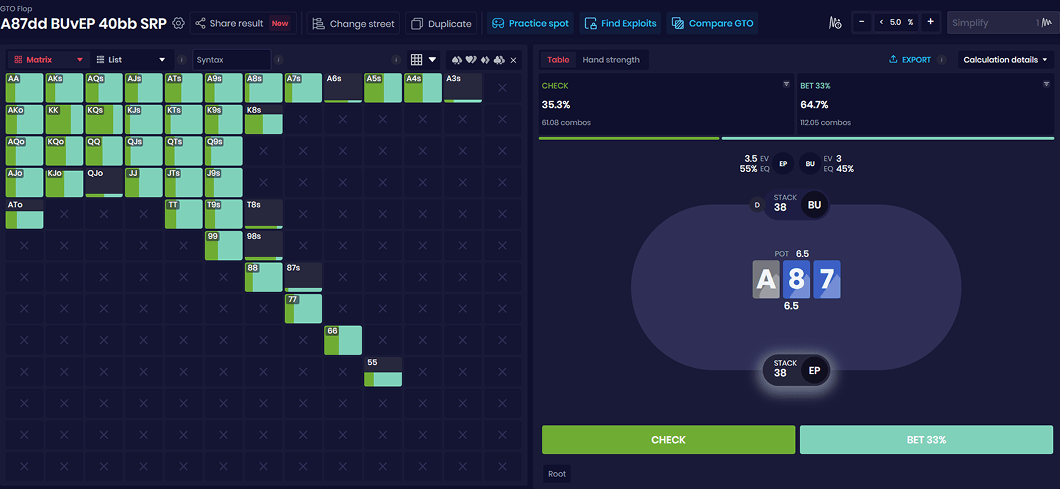
UTG vs Button: Strong Range, Aggressive Strategy
In this case, your equity advantage is 55% versus 45%, and your EV is 3.5 BB in a 6.5 BB pot.
In the UTG versus Button scenario, most of the hands you opened connect with this flop in some meaningful way. A large part of your range consists of hands that are at least one pair or better, while many of your misses are hands like offsuit broadways or suited broadways without a backdoor flush draw.
Overall, about 63% of your range is connected to this board. That is why the solver prefers a fairly aggressive strategy here, using a one-third-pot continuation bet around 65% of the time.
This is still far from an automatic c-bet spot, as it might be against the Big Blind, but it is clearly a proactive strategy.
The reason is simple: your UTG opening range hits this board quite well. You have many hands with enough equity to bet for value or protection, and enough hands that benefit from denying equity. In practice, if your opponent does not defend properly, you may even be able to c-bet more often than the solver suggests — although being out of position still requires caution.
Cutoff vs Button: Weaker Range, More Passive Strategy
Now, let’s compare that to the Cutoff scenario.
When you open from the Cutoff, you are incentivised to raise a wider, weaker range. As a result, you arrive on the flop with many more hands that qualify as air.
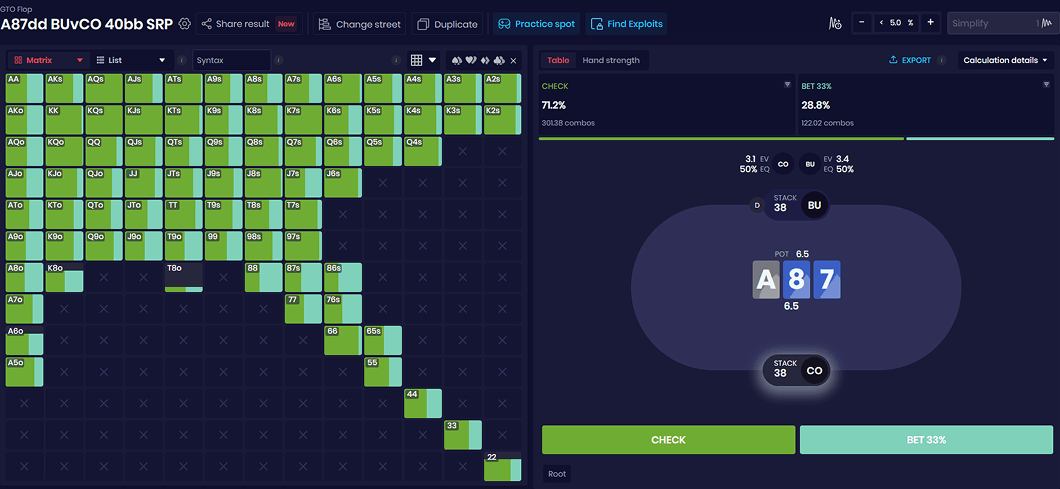
This is immediately visible in the numbers. Your equity is now roughly tied with the Button at 50% versus 50%, and your EV drops to 3.1 BB in the same 6.5 BB pot.
When opening from the Cutoff, around 53% of your range misses the A♠8♦7♦ flop. You now have far more King-high hands, weaker broadways, and underpairs that do not connect well enough to support frequent betting.
That leads to a very different overall strategy. Instead of betting often, the solver now prefers a check-heavy approach. You should check more than 70% of the time and use a one-third-pot bet with the remaining portion of your range.
So even though the board is the same, your strategy changes dramatically because your range is weaker.
A weaker starting range leads to a much more passive flop strategy.
How Should This Shape Your Approach?
There are many more variables we could explore, but this is enough to illustrate the core idea.
In real games, exact numbers will vary. Some opponents will arrive at the flop with wider ranges, others with tighter ones. Some players will overfold against c-bets, while others won’t stab often enough when checked to.
Still, the key lesson remains the same: always pay attention to the ranges both players bring to the flop. Avoid oversimplified rules such as, “Ace-high boards are automatic c-bets for the preflop aggressor.”
The same logic applies in other spots — you should never evaluate board texture in a vacuum.
Deepsolver helps you understand how changes in your range affect your opponent’s optimal response — and vice versa. That’s the key to evaluating hands more holistically and making better, more exploitative decisions.